


News
The “delicious joy” of creating and recreating music
Leslie Tilley combines deep experience as a musician with cultural and formal analysis to see how people refashion music anew.
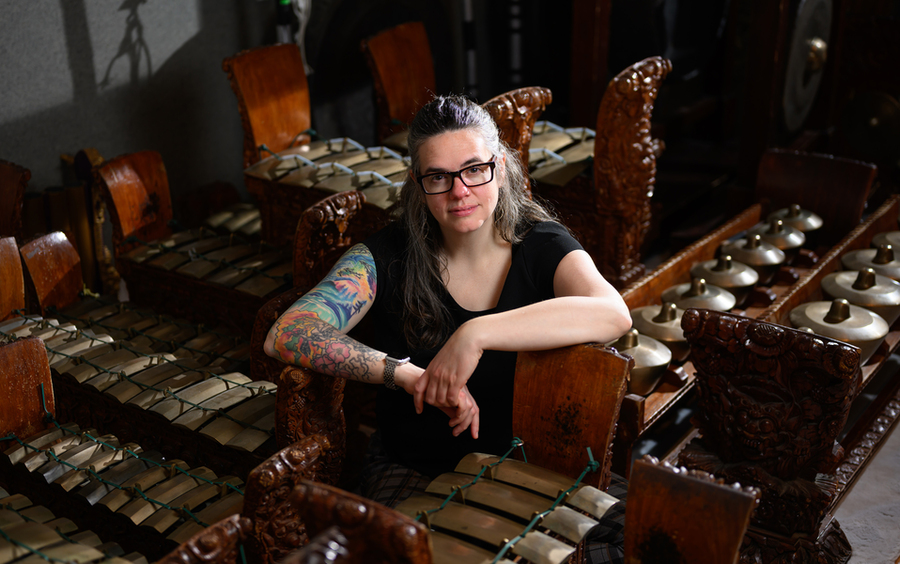
As a graduate student, Leslie Tilley spent years studying and practicing the music of Bali, Indonesia, including a traditional technique in which two Balinese drummers play intricately interlocking rhythms while simultaneously improvising. It was beautiful and compelling music, which Tilley heard an unexpected insight about one day.
“The higher drum is the bus driver, and the lower drum is the person who puts the bags on the top of the bus,” a Balinese musician told Tilley.
Today, Tilley is an MIT faculty member who works as both an ethnomusicologist, studying music in its cultural settings, and a music theorist, analyzing its formal principles. The tools of music theory have long been applied to, say, Bach, and rather less often to Balinese drumming. But one of Tilley’s interests is building music theory across boundaries. As she recognized, the drummer’s bus driver analogy is a piece of theory.
“That doesn’t feel like the music theory I had learned, but that is 100 percent music theory,” Tilley said. “What is the relationship between the drummers? The higher drum has to stick to a smaller subset of rhythms so that the lower drum has more freedom to improvise around. Putting it that way is just a different music-theoretical language.”
Tilley’s anecdote touches on many aspects of her career: Her work ranges widely, while linking theory, practice, and learning. Her studies in Bali became the basis for an award-winning book, which uses Balinese music as a case study for a more generalized framework about collective improvisation, one that can apply to any type of music.
Currently, Tilley is engaged in another major project, supported by a multiyear, $500,000 Mellon Foundation grant, to develop a reimagined music theory curriculum. That project aims to produce an alternative four-semester open access music theory curriculum with a broader scope than many existing course materials, to be accompanied by a new audio-visual textbook. The effort includes a major conference later this year that Tilley is organizing, and is designed as a collaborative project; she will work with other scholars on the curriculum and textbook, with 2028 as a completion date.